# Rearchitecting for Drupal 8; a DrupalCon Session
| key | value |
| --- | --- |
| url | https://www.frobiovox.com/posts/2018/02/15/rearchitecting-for-drupal8/ |
| date | 2018-02-15 |
| tags | rant, quarzack13 |
| description | This is an export of my session from DrupalCon Baltimore 2017. This is here for posterity. The least effort possible was put into transcribing it from presentation format to a web page. |
# Rearchitecting for Drupal 8
This is an export of my session from DrupalCon Baltimore 2017. This is here for posterity. The least effort possible was put into transcribing it from presentation format to a web page.
## In case you are wondering

## Hello My Name Is Frank
I am a Christian, Father, and Technology Enthusiast.
- *Online my name is* **frob** (IRC, [d.o](https://drupal.org/u/frob), github)
- *On Twitter I am* **[@frobdfas](https://twitter.com/frobdfas)**
- *My Blog is* [www.frobiovox.com](https://www.frobiovox.com)
- *I work for* [Clarity Innovations Inc](https://www.clarity-innovations.com).

Clarity Innovations is a professional services firm based in
Portland, Oregon focused on providing K-12 and higher education
technology consulting to non-profits, schools, and corporations.
We develop solutions for our clients including strategic consulting,
professional development and content creation, and engineering
solutions such as apps, web apps, and websites to help improve the
process and practice of teaching and learning.
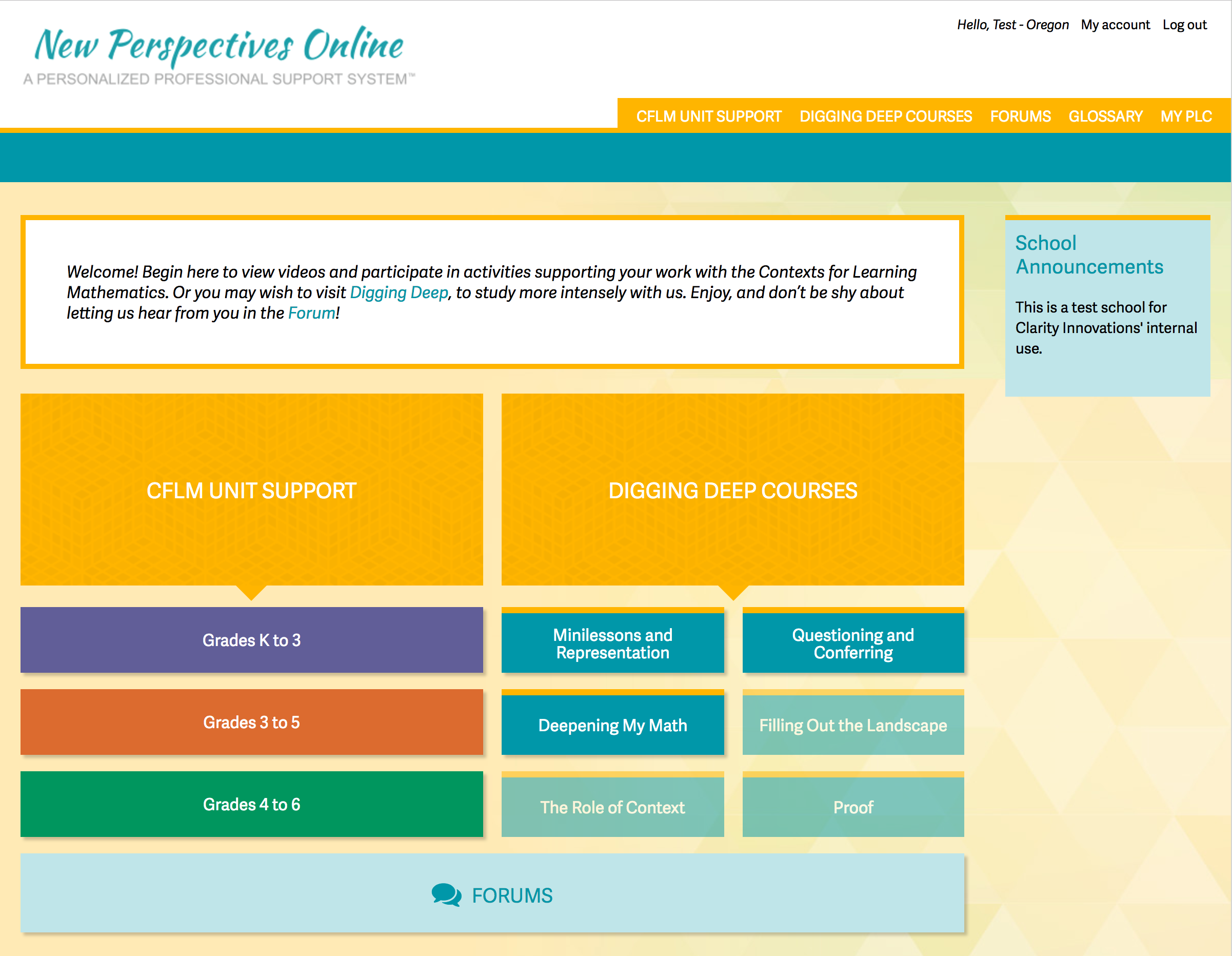
One such site is a custom LMS for our client New Perspectives Online.
## Why do [Drupal 8 Experimentation]?
- The big question is D8 or D7, this is a question that I have to ask
myself every time I am asked to do an estimate.
- How do we pick which version of Drupal to use?
- Let me **GET THIS OUT THE WAY** I will not be going over hard
numbers for building with one version over the other. I will give
you the only answer that I can give knowing what I know about your
project's requirements. IT DEPENDS.
### Bottom line
- I create with Drupal 7.
- I want to create with Drupal 8.
- I want to know the differences between creating with Drupal 7 vs 8.
- I would like to know how I can leverage the new features of Drupal 8
in complicated information systems.
### Lets go from:

#### To:

## Custom LMS Architecture
### Learning Management System
An LMS is software that allows for the organization and delivery of
courses or training programs.
#### LMS Architecture
Need to deal with some prerequisite information so we all understand
the goals of the project that I used as my test bed.
- What is an LMS? An LMS is a Learning Management System.
It is software that allows for the organization and delivery of
courses or training programs. If you have used buildamodule.com or
drupalize.me then you have used a LMS.
### Traditional LMS
- Curriculum or Lesson plan
- Unit or Module
- Lesson/Project/Assessment/Mini-lessons
- Traditional LMS is based on a traditional course or lesson plan
- Curriculum or Lesson plan
- Collection of Units or Modules
- Collection of Lesson/Project/Assessment/Mini-lessons
### Our custom LMS is structured
- Module -\> Menu
- Segments -\> Nodes or Content Type
- Components -\> Paragraphs Items
- Our custom LMS is structured as
- Module -\> Menu
- Segments -\> Nodes
- Components -\> Paragraphs Items
- Lesson plan equivalents are built with select fields on the
segment nodes.
## Basic Drupal Architecture

In order to make sure we are all on the same page moving forward I
need to talk about some basic Drupal Architecture. If this is review
for some of you, I am sorry for the unskippable tutorial level.
## Basic Drupal Content Architecture
Don't worry I will mostly just be talking about Entities, Fields,
and Variables.
### Entities
Entities are things in Drupal; things do not have to be nodes.
- Entities are things in Drupal, starting in drupal 7 we got content
entities.
- In Drupal 6 custom things were typically nodes or totally custom
- In Drupal 7 the entity-field system brought the CCK into core
without making everything a node
- Drupal 8 has a fully fledged entity api which is derived from the
capabilities of the contrib entity api module for drupal 7.
- Users, Taxonomy Terms, and Nodes, are all Entities
#### Bundles and Fields
- A bundle is a collection of fields instances on an Entity
- A field instance is a place for complex data in a Entity Bundle
- A property is simple storage for Entity level data
An Entity can have Bundles to allow for multiple collections of
fields instances on a single type of entity.
- Field instances are unique to that bundle.
- An Entity has properties which span all bundles.
- created date
- node status
- who created are all properties
- A field instance is a place for complex data in a Entity Bundle
- A property is simple storage for Entity level data
#### Properties
Properties are linked to an Entity, such as Node. Fields are linked to
the Bundle, such as Content Type.
Properties are stored on the entity's table and fields are stored in
their own table.
#### Variables
Variables are what Drupal 7 provides for configuration \--when it isn't
a custom table.
### LMS Features
Support Backwards Design philosophy
- Site Features
- Traditional LMS
- Collection of Curriculum or Lesson plans
- Collection of Unit or Module
- Collection of Lesson/Project/Assessment/Mini-lessons
- Curriculum Designer will often use a Backwards Design philosophy
- Starts Standards/Topical they with to teach
#### Goals of lesson planning
Using the 5 e's as the goals of lesson planning.
- Engage
- Explore
- Explain
- Elaborate
- Evaluate
#### LMS Lesson Goals
- Teaching
- Application
- Assessment
Thus Goals for Lesson Plan Features.
- Activate Prior knowledge
- Modeling or Teaching
- Practice
- Application
- Assessment
Our custom LMS is structured as
- module -> menu
- segments -> nodes
- components -> paragraphs items
## Drupal 7 Modules Used
*[Frank's list of modern site building
tools](https://www.frobiovox.com/posts/2015/09/22/modern-drupal7-site-building-tools.html)*
I gave a talk on modern Drupal 7 development at a meetup in Portland
last year, and I am not going to go into great detail here. I wrote
a blog post about it and if you would like more details I suggest
you look there.
- I will go over the modules that this site used (in its core
functionality), what they do.
- Later I will go over how they relate to Drupal 8.
- Remember when building a site that the output that drupal give us is
always a suggestion. The important part of site building is giving
the content team everything they need, you can leave it up to the
developers and themers to make sure that the content gets displayed
properly.
### [Paragraphs](https://www.drupal.org/project/paragraphs)
Paragraphs allows us to create collections of fields. Each collection
type is its own bundle and can have its own fields.
- Paragraphs \-- If you are familiar with field collection then this
module functions very similarly, with the main exception of the user
being able to pick the bundle or paragraph type when creating
content.
### [Entity Form](https://www.drupal.org/project/eform)
Named eForm in Drupal 8. Allows the use of the field api to create
webform and have the submissions be entities.
- Entity Form \-- In Drupal 8 this module was renamed to eform. The
cool part of this module is that it allows us to use the field api
to create webforms. Unlike the webform module, the form submissions
are entities. This gives us flexibility use in views or displaying
them with multiple view modes.
### [Eva](https://www.drupal.org/project/eva)
Solves the problem of putting views into entities as pseudo-fields.
- EVA \-- Entity View Attachment. Allows us to embed views into
fields. Handy for things like Taxonomy term views or anywhere an ID
can be used as an argument in a view.
### [Flag](https://www.drupal.org/project/flag)
This module allow users to flag things. Largest use is probably the
"Flag this as inappropriate" functionality.
- Flags \-- This module allow users to flag entities. Largest use is
probably the "Flag this as inappropriate" functionality.
- The last two modules don't have much to do with this site per-se
but they are fantastic modules that will really help a site-builder.
### [Coffee](https://www.drupal.org/project/coffee)
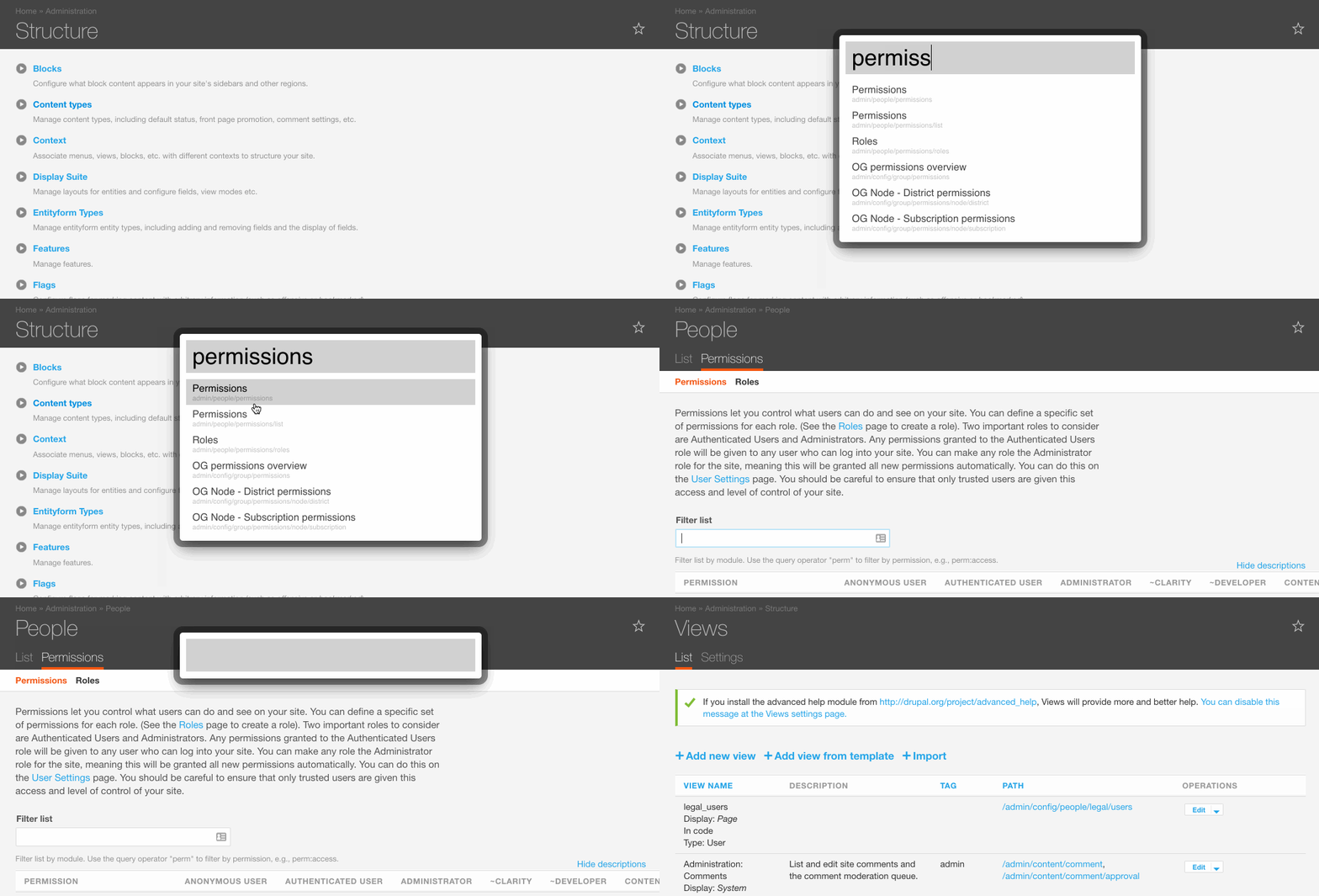
Coffee works like Unity for Ubuntu or Spotlight search for Mac, or the
Start Menu in Windows. Just start typing and a list of options will be
presented. Pick the option and it will take you there.
- Coffee \-- Speed up your Drupal navigation by typing where you want
to go. Much like unity for Ubuntu or Spotlight for Mac or Start for
Windows, this module allows us to zip around our site's admin
interface with ease.
### [Speedboxes](https://www.drupal.org/project/speedboxes)
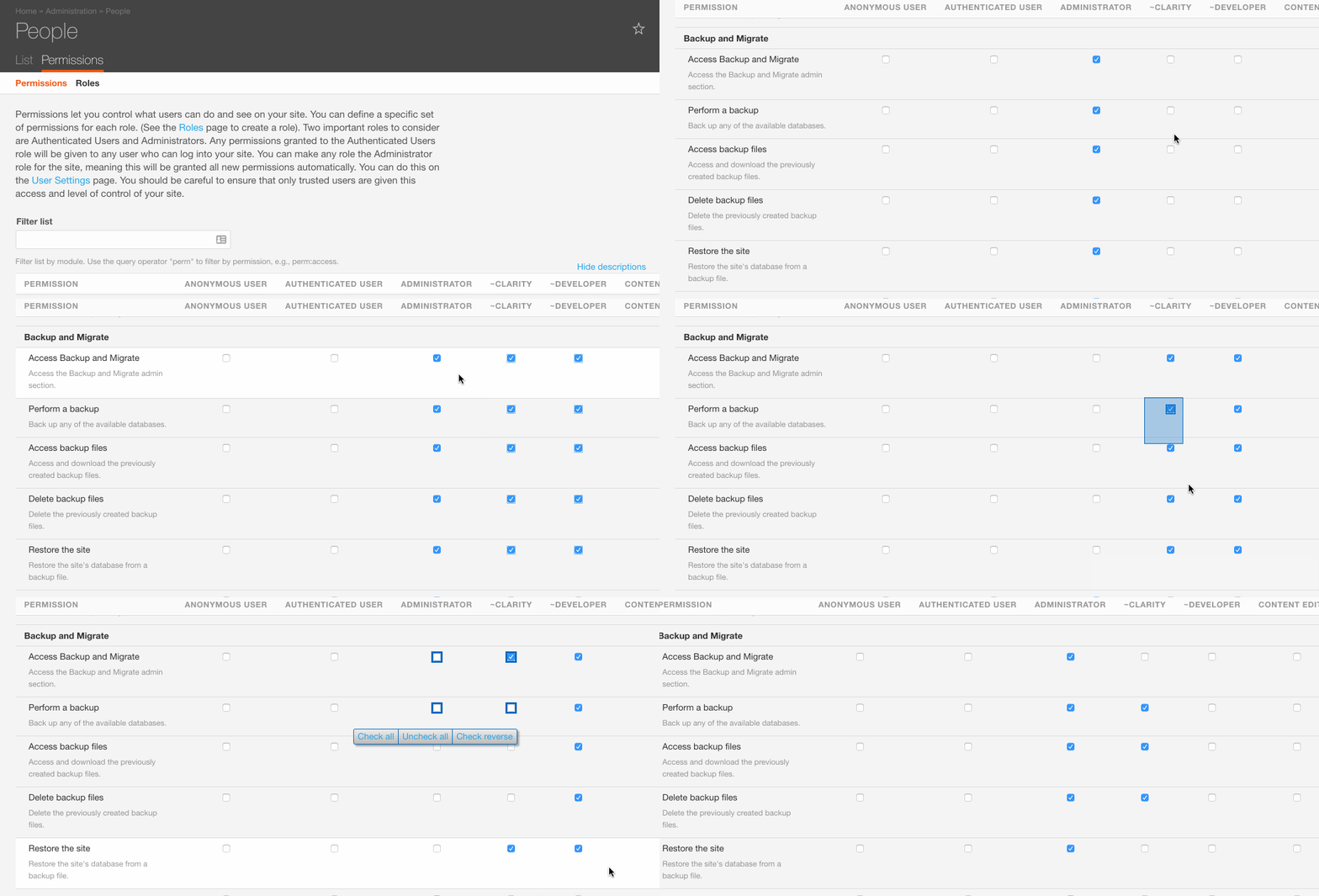
Check more than one box with a click and drag mechanic.
- Speedboxes \-- Allows us to check multiple checkboxes at the same
time. Super useful for setting up permissions.
### A word on Blocks
[Bean](https://www.drupal.org/project/bean)
Bean is an acronym that stands for:
**B**lock **E**ntities **A**ren't **N**odes.
- This is not a block heavy site
- It works mostly as an app with the blocks only really being used to
place active menus on the screen.
- This is mainly because there are not many reusable pieces to the
site. If it isn't a page level thing then it really isn't a part
of this site.
- This site doesn't use blocks, but when I use blocks I build them
with BEAN.
- Bean gives us all the functionality of building content types with
nodes except with blocks instead.
- I normally add a content view for beans at /admin/content/blocks and
I disable the default drupal block management stuff, with the
exception of block placement. because that is still necessary.
- But again, this site didn't make heavy use of blocks.

I don't always use blocks, but when I do I use the bean module
### LMS Content Strategy
Arguably, the most important part of a site.
- Content Strategy
- Now thats out of the way we can talk about the site's content
strategy.
#### 13 paragraphs types and 1 content type
In the end our site had 13 paragraphs item bundles for 1 content
type and three were interactive.
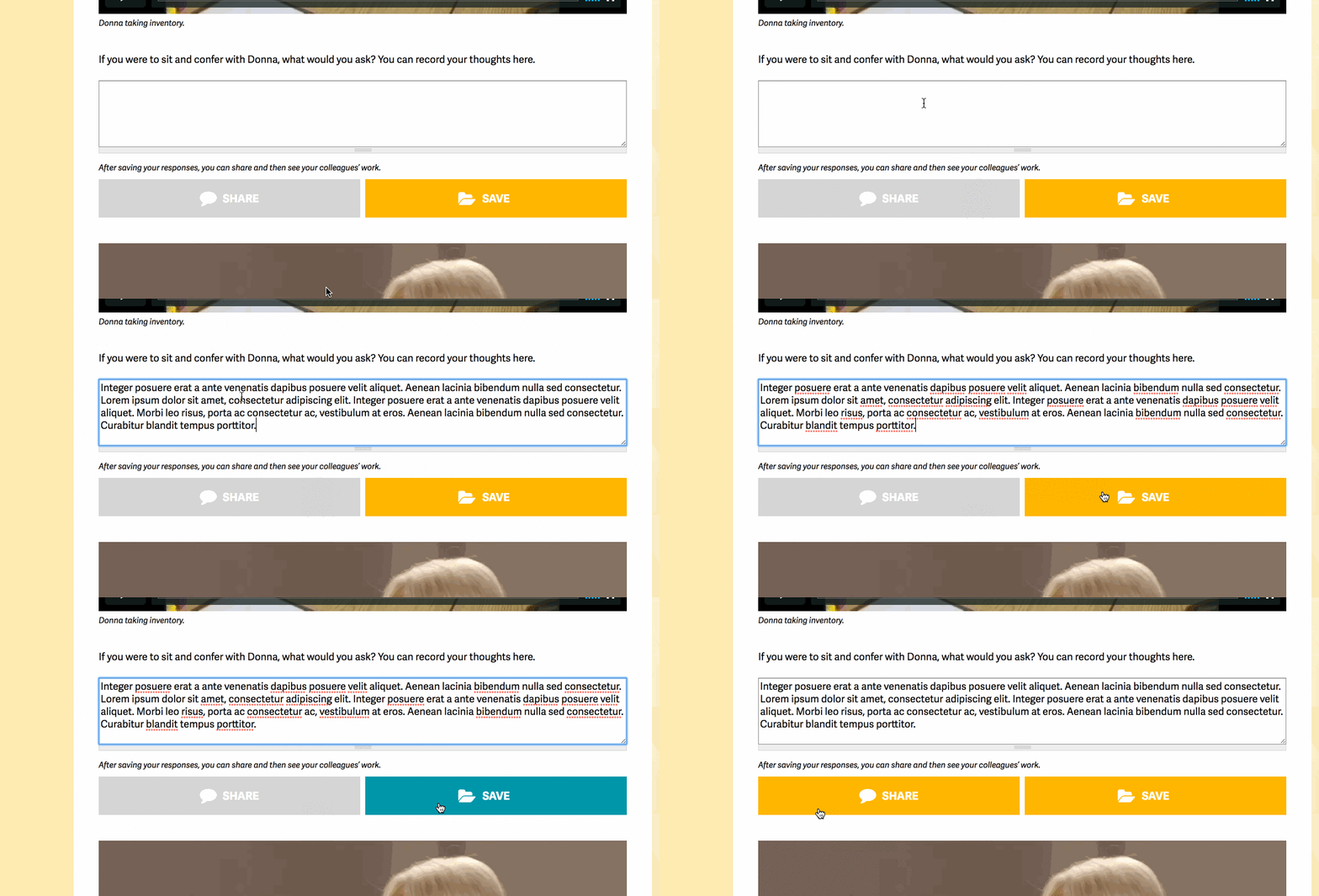
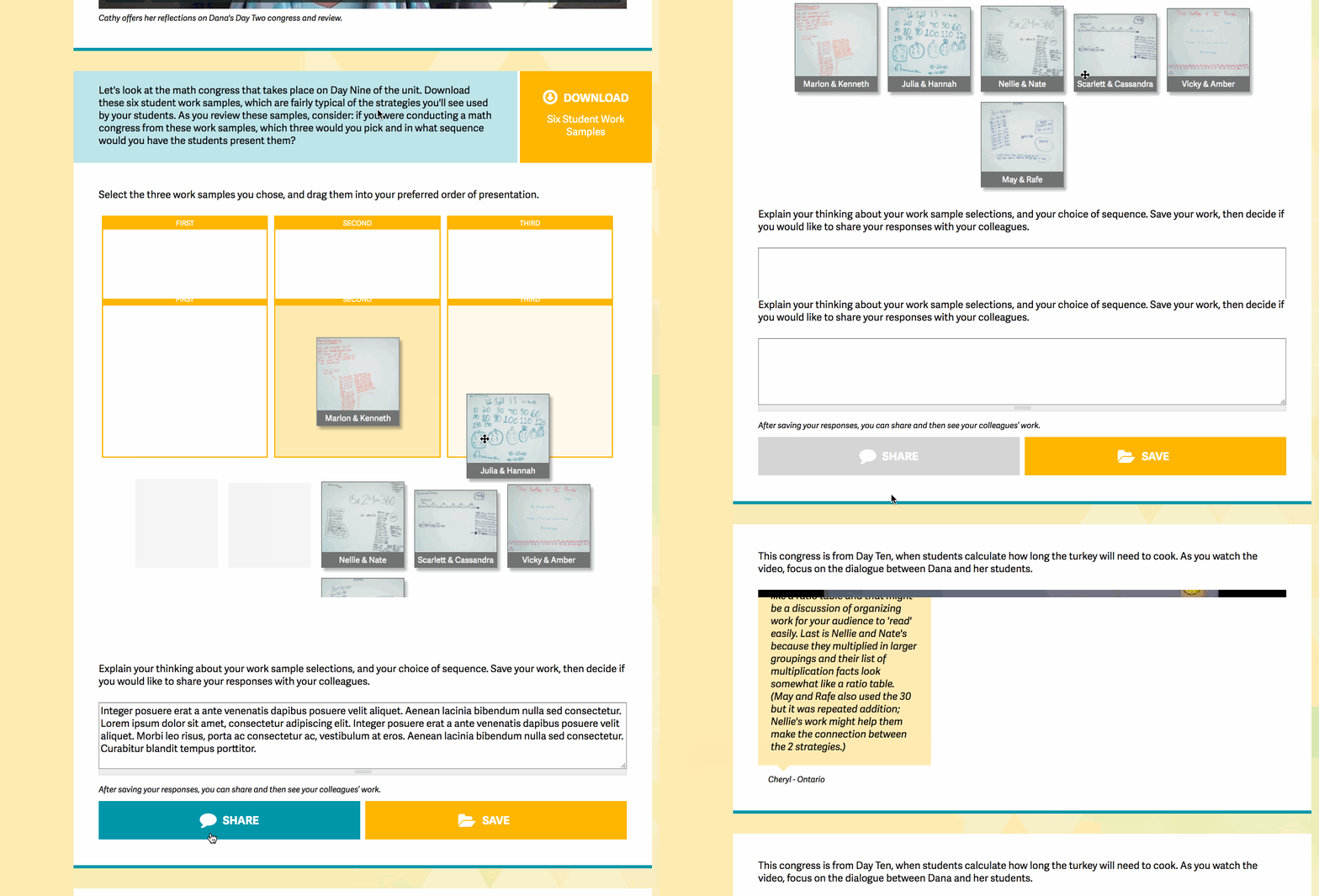
- Text response
- Checkbox list
- Drag and Drop
##### Text response
##### Checkbox list
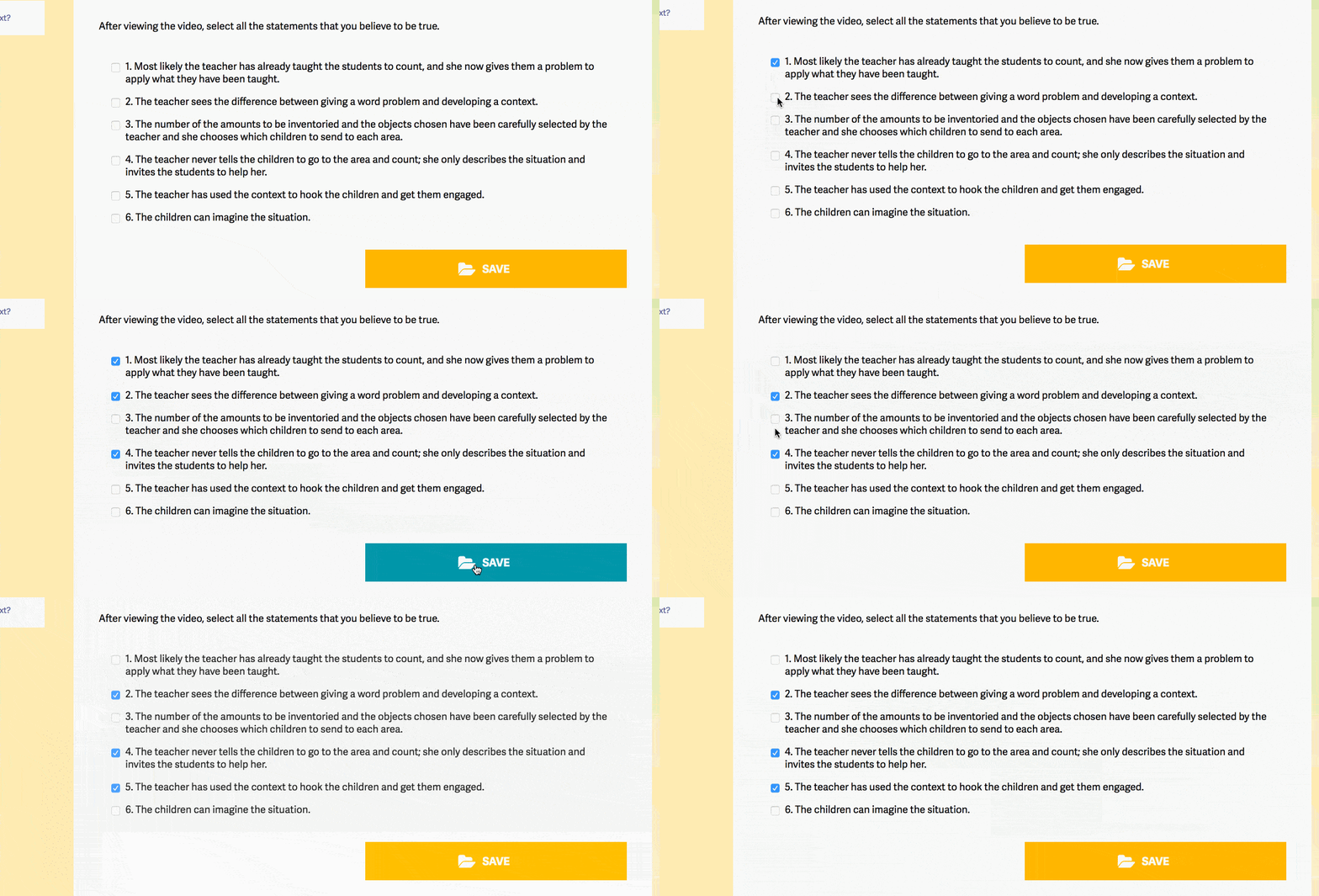
##### Drag and Drop
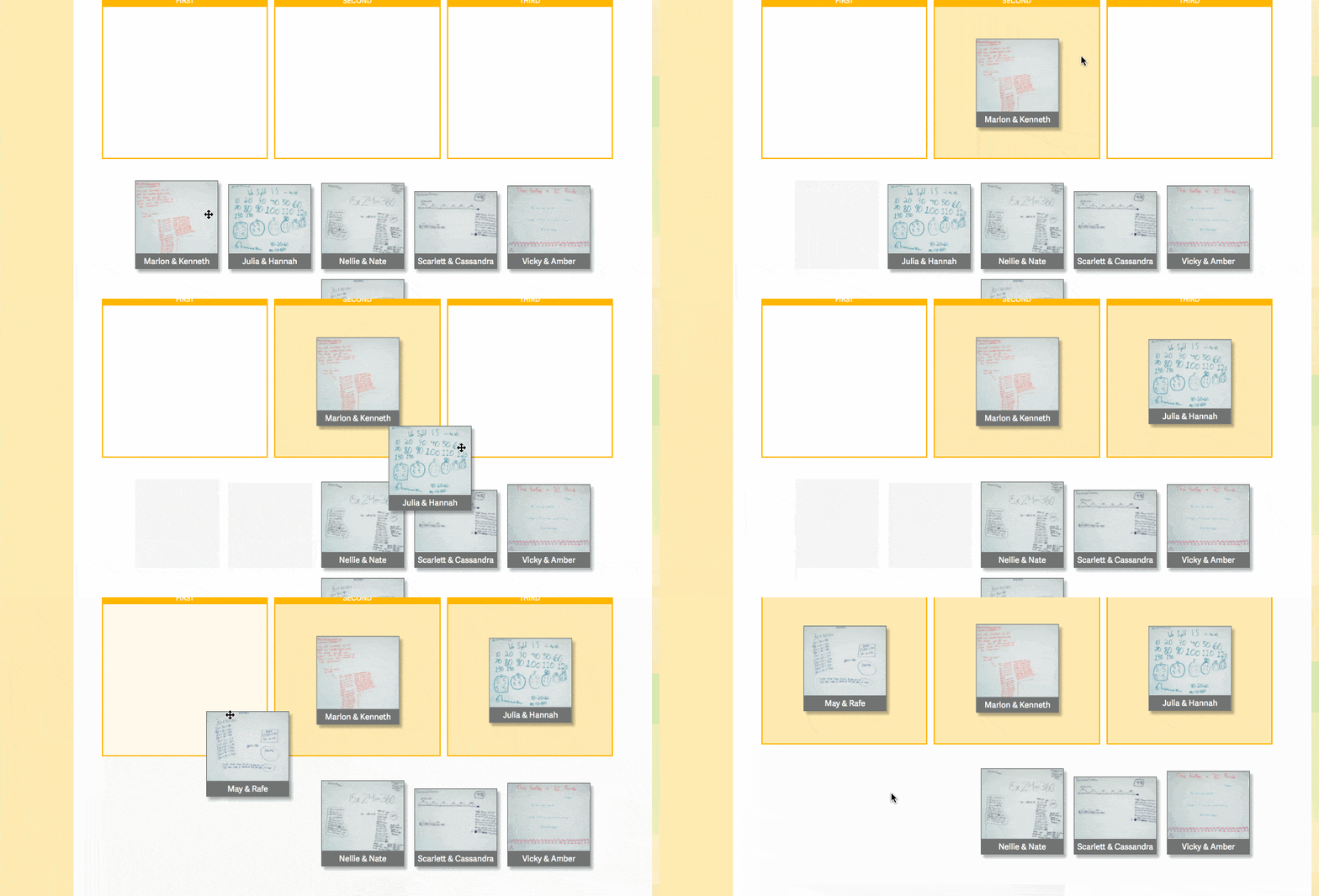
#### The rest are multimedia/content.
Everything can be *combined* to form larger whole components.
- Four were used for custom inter and intra module navigation
- The rest were videos, image, and text.
- all can be combined to form larger whole components.
#### Linking the EntityForm Submission to the Paragraph item
Entity | Machine Name
----------------- |----------------
Paragraph Type | text\_response
EntityForm Type | text\_response
Linking the EntityForm Submission to the Paragraph item, each
interactive paragraphs item had a corresponding entity form with an
entity reference back to the paragraphs item that displayed the
form. We used the paragraphs item's bundle machine name to pick the
bundle of the EntityForm to display.
We put this all together, using Drupal's ingenious render array
system that doesn't care if it is displaying a form, or
content, or anything themable, we were able to HULK smash the
entityforms into the paragraphs item displays and save any users
response and know what they were responding to and who was
responding to it.
#### Evaluation
Sharing via Flags on the paragraphs items
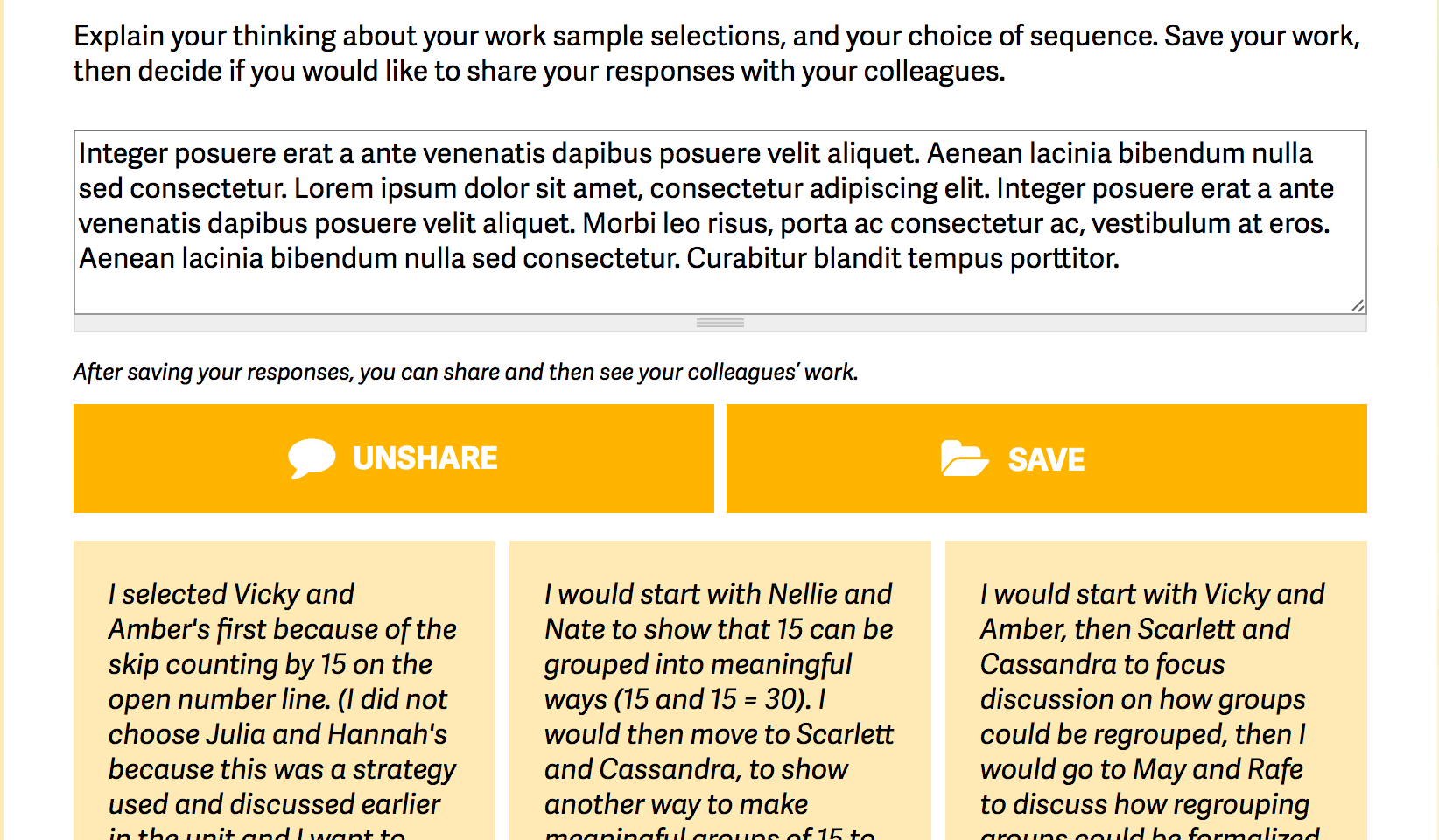
We also had to allow for self evaluation. Our client wanted users to
be able to share their responses and learn from the responses of
others. So we used flags that let the users share their responses,
in turn if they share their response then they see their peer's
responses and then they can edit their old response and save a new
one.
Our initial expectation was that we would have to build out all the
content in a spreadsheet and at one point I was building a migration
to import all the content from a CSV. Choosing the Paragraphs module
gave our content editors an interface that allowed them to build the
content in the site as we were adding functionality.
### Custom Development
The meat of how we are putting this together is in the
hook\_entity\_view\_alter implementation and the hook\_form\_alter
implementation.
#### Pass the build to custom function
```php
item_id)) {
module_load_include('inc', 'entityform', 'entityform.admin');
$entity_form_name = 'text_submissions';
$component_id = $build[0]['#entity']->item_id;
$entity = $build[0]['#entity'];
$form = _get_entityform(entityform_empty_load($entity_form_name), array('component_id' => $component_id, 'entity' => $entity));
$form['field_component_submission']['#attributes']['class'][] = 'element-invisible';
// ... Other Stuff ...
$form['field_text_response_submission']['#attributes']['class'][] = 'component-input-no-label';
$form_rendered = drupal_render($form);
$build[0][] = array(
'#type' => 'markup',
'#markup' => $form_rendered,
'#prefix' => '',
"#suffix" => '
',
"#weight" => 100,
);
}
}
```
In the case of the text response this checks for a valid callback
and runs this code to include the entity form.
Then in the form\_alter we change the actual form options or the
text area label to use the correct text.
Things get complicated at this point, because ajax. We have to ajaxify each of the paragraph items. I'm not going
to go into code here because that would just be boring, and it
is better documented elsewhere.
An interesting thing about saving a response is, only after it
is saved can we make the paragraphs item sharable. Then after it
is shared only then can we make show the shared responses. All
of these things required heavy development for Drupal 7, and
will likely also require lots of custom work for Drupal 8 too.
## Considerations Building a LMS with Drupal 8
- Architectural differences
- UI Changes
- Module availability
- Specifically What needs to change
- Architecture
- Custom Development
- Content strategy
### General Drupal 8 Considerations
- devel kint debugging DO NOT USE KUMO it doesn't work on real
objects
- no longer cache clear now cache rebuilding
- No more module disable, uninstall or die
- [Enable developer mode](https://www.drupal.org/node/2598914)
- Nice thing is that there is lots of information available
already for Drupal8 the problem is that there is lots of bad
information available for Drupal 8. Check your sources and do
not expect everything you read to actually work. Even d.o
documentation can be out of date. poll module example.
### Architectural Differences
I am not going to give you an exhaustive list of new Drupal 8
features and in the end I will just give you a list of things to
google.
#### Configuration Entities
I am not going into detail about them other than to say
generally that the configuration management initiative changed
so much with regard to developing and deploying Drupal. All for
the better. If you are committed to stick with the db-sync
workflow, it still works with Drupal 8 but really learn as much
as you can about configuration entities and what you can do with
them. Really this could be a talk or two on this, and I don't
have the time in this talk to do them justice.
I will say that configuration entities gives drupal a place
other than a random variable to store configuration and keeps
developers from having to manage a bunch of tables if they
needed something more complex than a simple variable could
offer.
#### Blocks
Blocks now function much like nodes insofar as they are full
fledged entities with bundles and fields.
Blocks still have an Achilles heel in that they are both content
and configuration. The content lives in the database and isn't
easy to export and sync and the placement of the block is
configuration and is easy to sync. This can lead to embarrassing
deployment gaffes. Where the placement of a block that doesn't
exist is possible. [Here is a good article about avoiding that](http://valuebound.com/resources/blog/how-to-sync-blocks-between-different-environments-a-drupal-8-website).
#### Display Modes
##### Content View Modes
If you used the entity view modes modules or display suite
to provide view modes for content types and such, then you
should already be familiar with this. If you don't know
what view modes are, they are ways for providing different
ways to display the same content. So for a node we could
have a teaser or a full view mode or a grid view mode.
Basically anything that the design called for. These existed
for content in Drupal 7 but they required a contrib module
such as entity view modes or the display suite module to
configure them without code. Drupal 8 gave a full fledged UI
to work with.
##### Form View Modes
All that stuff I said about being able to display content in
different configurable ways now also applies to forms with
Drupal 8. So, as an example, let say you have a very
complicated user registration form because your client wants
to collect a bunch of information about the user, but none
of it is required. Now you can create a new simplified form
for adding users. You can do this in the UI in Drupal 8.
### Things to google (many have been backported to Drupal 7)
- Composer support
- Toolbar update (Navbar in Drupal 7)
- Responsive Image Styles (Picture Module in Drupal 7)
- File Entities
- RESTful api
- Experimental Core Modules
- Content Moderation
- etc\...
### UI Changes
**Good News!** Not much has changed significantly in the UI. I guess
that could be bad new too.
- This is going to be brief, mainly because the UI changes are
minimal.
#### Operations
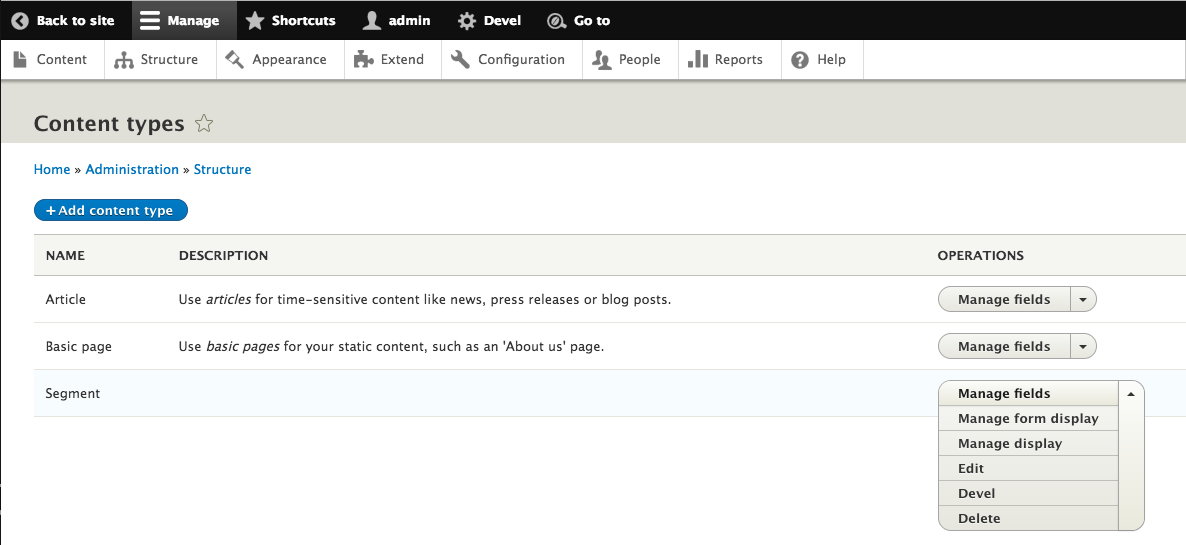
New Drop down thingy for selecting what we are doing to a thing. One change is Operations now go in a drop down with the maybe most
common one first? Really I don't know how that was chosen so if
someone here does know please tell me afterward.
#### Form Display Settings
Multiple entity form settings on the Manage form display page, this
includes field widget settings.
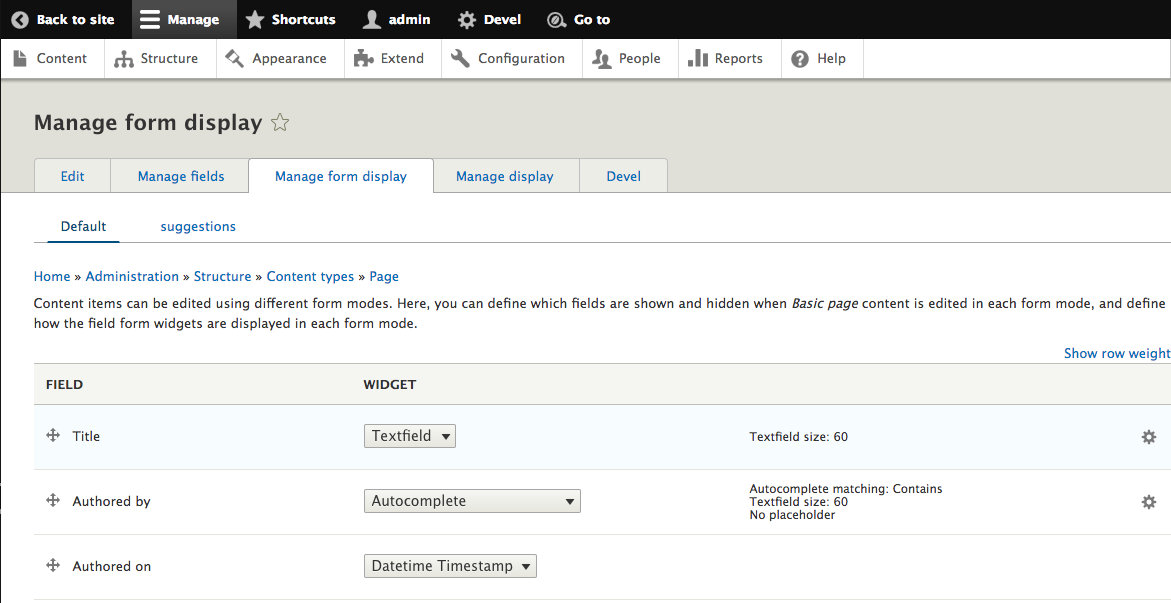
Another change you will find between D7 and D8 I have already hinted
at with the Form View. If you have a alternate node form then you
will find the option for editing that form view in "Manage Form
Display" section. This also means that controls for the form
widgets are configured on the form view display settings and not the
"Manage Fields" page. Mange Fields is now entirely about the field
and its storage.
#### Good news about learning curves

Good news, there are fewer changes for site builders who are coming
from Drupal 7 to worry about. Bad news is for someone coming from
not Drupal the perceived Drupal learning curve could be
intimidating.
### Module Availability
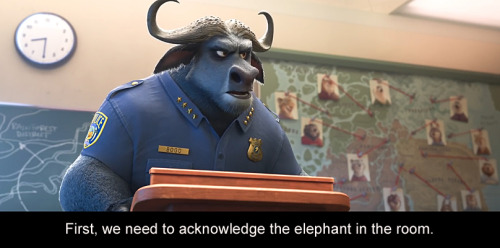
**Big problem with my re-architecture exercise.**
EntityForm is not supported on Drupal 8.There is a discussion about whether or not this module is necessary. I of course believe the module is necessary. However, this doesn't make the module stable today. The module works well enough for this experiment, but if this were a full client project we would have to explore some options.
- Find an alternative
- Custom Entities are an option
- Comment module
- Contact module extras
- Relation module
Didn't bring this module up in the modules used because we didn't use it, but this is a really cool module. This module has the ability to supplant the functionality of flag and organic groups. It adds the concept of entity endpoints which allow us to make fieldable relations between entities. In the example of this LMS that entity would have all the fields for the response, an endpoint for the paragraphs item (renamed paragraph revision for Drupal 8), and an endpoint for the user.
I have used this module for saving user state in js apps and for keeping track of users completion status for resources in custom Professional Development portals.
- Fund the development of a stable release.
While I do encourage finding alternatives, at this state in Drupal 8 development I would encourage us to choose the final option because, frankly, aside from the comment module none of the above options are any more stable than eform and more importantly Drupal 8 needs more stability in contrib.
**Second problem**
- Paragraphs doesn't want me to reference paragraphs
- It is possible, but requires use of the EXPERIMENTAL field
widget. The main reason this is EXPERIMENTAL is that the
paragraphs modules is not mean to be used to reuse content, that
is more of a function of blocks. I spent more time on this than
I would have liked, due to some of Drupal 8's UI changes that I
didn't fully understand. But it turned out to be a non-problem.
- In this case the problem wasn't the module but my own
unfamiliarity and over confidence. The answer was staring me in
the face.

So we do have an elephant, but it is just a baby elephant.
### Specifically What needs to change
**Not Much**
- This site works more like a an app than a traditional site, this
means we have slightly different expectations when choosing a
Framework.
- Drupal was chosen for its scaleability, strong user centric or
permissions based content model, high quality contrib space, and
familiarity. As I said before I have been doing drupal
professionally for close to 10 years, so I am very familiar with the
project, community, and workflow. However, I am constantly looking
into other technology and I have built things with other tech when
Drupal isn't the best choice, so this isn't a statement coming
from the island.
- Drupal 8 has lots of new Features but the biggest advances have been
in underlying architecture (with the content/config entity system)
and development workflow (with the switch to Semantic Versioning).
#### Architecture & Content Strategy
**Mostly the same**
- Same Features
- Same Modules
- Same Architecture
- Same Strategy
- Architecturally the site remains the same
- The site has the same features and the same modules are
available to provide us with the same architecture and content
strategy.
- It won't always be like this. But if you put the work into
making sure you have a good content strategy in the first place
it will be less likely that you will have to completely
re-architect a site when you move platforms. This is why content
strategy is important.
#### Custom Development
**Biggest Changes**
- The largest change is the addition of developing a stable release
for whatever we use for the response saving.
## Custom Development
This is where the largest changes were made.
- Custom development
- This is where the largest changes were made, but maybe not where it
was expected.
### Not Much
- We still use hook\_entity\_view\_alter
- We still use hook\_form\_alter
- In Drupal 7 we accomplished the HULK SMASH part, where we smash the
form from the entity form into the display of the paragraphs item,
with a hook\_entity\_view\_alter implementation coupled with a
hook\_form\_alter implementation. In Drupal 8 with its Object
Oriented Architecture I was able to accomplish it in the exact same
way.

- "But Wait" you say, "Drupal 8 is OOP we aren't supposed to put
stuff into the .module file anymore. That is just there for
decoration!"
- Oh no, the joy of modifying aspects of the program with hooks is not
gone in D8. Hooks are good things, and even though Drupal is want to
change things with new version and add modern development practices
to Drupal, Drupal also isn't going to ditch what is likely the most
flexible pattern of php development just because it stepped in some
OOP.
### Okay, really lots
But all good!
- The Object Oriented Architecture is designed to make common things
easier.
- For example.
- When building this with Drupal 7, we had to reimplement parts of the
form builder from the entity forms module in order to display entity
forms programatically. This was likely due to the incomplete nature
of the entity api in Drupal 7.
- In Drupal 8 the entity api is far more fleshed out. We still use
Entity Field Queries to get the EntityForm Submission for the
current user and the current paragraph revision, but this time
Drupal has an api for creating the empty EntityForm submission
object if the user has never submitted. And it has an interface for
building forms for Entities, new or old. Thus we can get a form for
a new entity in the same way we get the form for the old entity,
with all the right fields filled in.
*Drupal 8 version*:
```php
getStorage('eform_submission')
->create(['type' => 'multiple_choice_question']);
// This loads an existing eform submission.
$submitted_eform = \Drupal::entityTypeManager()
->getStorage('eform_submission')->load(2);
// Either way we build the form with a call to the entity.form_builder service.
$form = \Drupal::service('entity.form_builder')
->getForm($submitted_eform);
// Then we append it to the render array.
$build[] = $form;
```
- To build a new entity, this could be a node, eform\_submission, or
comment, We user the Drupal::entityTypeManager class and call the
create method or to load an existing one we use the same class with
the load method and the entity id.
- Then we user the entity form builder service to build the form for
the entity. I tested this with nodes as well. It is the same generic
interface for all content entities.
- No more Drupal 7 non-existent entity api
- Drupal 8 has intelligent use of OOP that makes site building easier
- Over 100 lines of code is reduced to under 10

- No more Drupal 7 non-existent entity api
- Drupal 8 has intelligent use of OOP that makes site building easier
- Over 100 lines of code is reduced to under 10
- Mind Blown
**The End**

## When are sprints?
April 24-27: Sprint Lounge at Baltimore Convention Center
April 28: **Sprint Day** - General Sprints, Mentored Core Sprint,
**First-Time Sprinter** Workshop at Baltimore Convention Center
We also provide a 24-hour Sprinter Lounge that opens on April 24th at
7:00pm and will close on Thursday, April 27th at midnight. The Sprinter
Lounge will be located at the **Hilton Baltimore (401 West Pratt Street)
in room Peale A-C**.
Based on community feedback and input from the Sprint Leads, we
understand the need for 'shorter sprints with greater support', and as
a result will **not** be hosting Extended Weekend Sprints at this
DrupalCon.